
Designing for Low Pitch Roofs
Online
Designing for Low Pitch Roofs
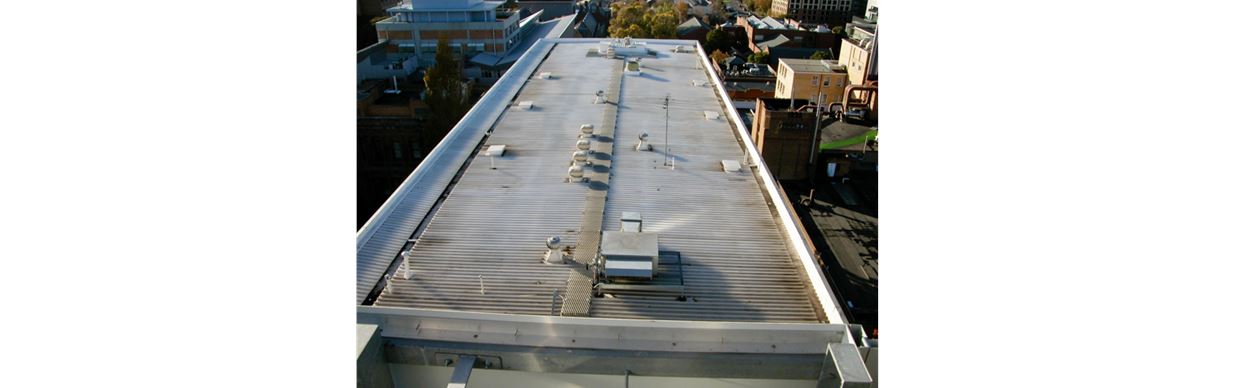
The delivery of waterproof and durable long-span low pitch roofs is a key issue in many industrial, commercial, and public buildings. Research shows that waterproofing defects remain one of the key sources of aggravation for building owners and occupiers and this often spills over into disputes and legal action.
Planning height constraints, architectural considerations and cost management are just some of the key reasons that encourage the use of low pitch roofs.
As a result, long span metal deck roofing in Australia and New Zealand is often designed and installed at the minimum pitch recommended by the manufacturer, which can be as low as one degree.
This compares with traditional rules of thumb used by architects, building designers, builders and engineers that suggested a minimum pitch of 3 degrees on steel and 4 degrees on timber structures as being the lowest practical pitch to avoid ponding and leaks at junctions, particularly where the roof is frequently accessed for maintenance without the benefit of a separate walkway structure.
Although the Australian National Construction Code, the New Zealand Building Code and Australian and NZ Standards permit low roof pitches with metal deck roofing providing they are approved by the manufacturer, this Mecca webinar examines how architects, building designers, hydraulic engineers and roofing contractors can deliver low pitched roofs with adequate performance and durability, and happy clients down the track.
The delivery of waterproof and durable long-span low pitch roofs is a key issue in many industrial, commercial, and public buildings. Research shows that waterproofing defects remain one of the key sources of aggravation for building owners and occupiers and this often spills over into disputes and legal action.
Planning height constraints, architectural considerations and cost management are just some of the key reasons that encourage the use of low pitch roofs.
As a result, long span metal deck roofing in Australia and New Zealand is often designed and installed at the minimum pitch recommended by the manufacturer, which can be as low as one degree.
This compares with traditional rules of thumb used by architects, building designers, builders and engineers that suggested a minimum pitch of 3 degrees on steel and 4 degrees on timber structures as being the lowest practical pitch to avoid ponding and leaks at junctions, particularly where the roof is frequently accessed for maintenance without the benefit of a separate walkway structure.
Although the Australian National Construction Code, the New Zealand Building Code and Australian and NZ Standards permit low roof pitches with metal deck roofing providing they are approved by the manufacturer, this Mecca webinar examines how architects, building designers, hydraulic engineers and roofing contractors can deliver low pitched roofs with adequate performance and durability, and happy clients down the track.
- Do membrane roofs, which are common in Europe and the US, offer a realistic alternative to low pitch metal deck roofs and in what circumstances might they be considered?
- Do siphonic drainage solutions offer benefits in Australian conditions, particularly as horizontal drainage runs can be flat and therefore can be contained within the depth of the roof structure?
- Are roll-on-site metal deck solutions superior to the alternative of using standard lengths. What are the pros and the cons?
- Control of condensation and mould on the underside of low pitch roofing, including insulation and vapour barriers.
- Insulation and sustainability.
- Design of roof penetrations at low pitches; issues and solutions.
- Should planning rules on height be reformed to focus on effective height rather than overall height where overshadowing and sightlines are not key considerations, allowing the use of higher pitches and deeper roof structures?
- Low pitched roofs may reduce embodied energy, but is this sufficient to counter other sustainability issues that may arise?
- Resolving roof drainage design and roof drainage maintenance on taller buildings where access to eaves gutters may be problematic.
- Rain noise issues with metal deck roofing.
- Designing the next generation of concrete flat roofs. Warm roof systems and exposed concrete ceilings.